
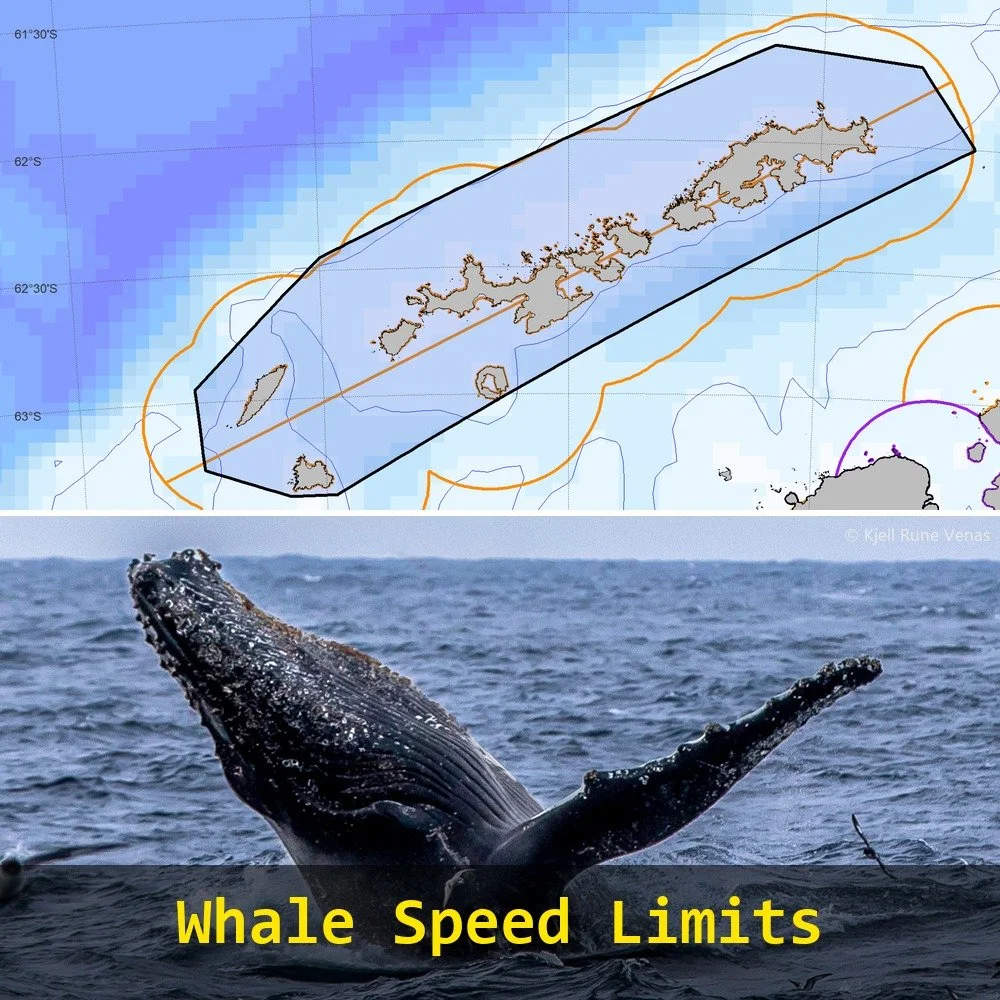
From 1 November, ARK member vessels will sail no faster than 10 knots in four areas where whales gather around the Antarctic Peninsula and the South Orkney Islands. The measure covers about 59,000 km² of sea and uses the same areas, dates and speed as Antarctic tour ships.
ARK members have adopted a new voluntary measure for the 2026/27 fishing season. Inside four areas, around the South Shetland Islands, Elephant Island, the South Orkney Islands and the Gerlache Strait, member vessels will keep their speed at or below 10 knots (about 18.5 km/h). The limit applies every year from 1 November to 30 May, the months when whales are most present on the krill grounds.
Why now. Baleen whales such as humpback and fin whales are recovering in the Atlantic sector of the Southern Ocean (CCAMLR Subareas 48.1, 48.2 and 48.3), often in the same waters where krill vessels fish. More whales means more encounters with ships, especially around islands and in narrow straits. ARK members chose to act before any formal requirement.
Why 10 knots. A joint workshop of the International Whaling Commission (IWC) and ACCOBAMS found that the risk of a lethal collision drops substantially below 10 knots, and noted that 10 knots is widely used as an advisory limit. The United States has required ships to keep to 10 knots in key right whale areas along its Atlantic coast since 2008.
One rule for fishing and tourism. The ARK areas follow the Geofenced Whale Areas set by the International Association of Antarctica Tour Operators (IAATO). Tour operators have kept to 10 knots in the Gerlache Strait since 2021, added the South Shetland Islands and Elephant Island in 2025/26, and are trialling an area around the South Orkney Islands from this season. Fishing and tourist vessels now follow the same speed, the same dates and the same boundaries in the waters they share.
Part of a wider effort. The speed limits join ARK's other voluntary measures. Since 2018, member vessels have stayed out of buffer zones around penguin colonies during the breeding season. ARK also supports research on how whales behave around fishing gear and acoustic monitoring of whales in the Gerlache and Bransfield Straits. Full details of the new measure are located on our Projects page.
Recovering whale populations are a conservation success. Slowing down where whales gather helps keep it that way, and puts the krill fishery and Antarctic tourism on the same footing.