
Beyond the Cap: A Fresh Look at Antarctic Krill Limits
The Antarctic krill fishery closed on 12 August after reaching the 620,000 tonne trigger level for Area 48, the second consecutive season to end on a precautionary limit. The trigger is not a measure of the krill stock. CCAMLR's own scientists say so in writing, and the date a fishery reaches it says nothing about how much krill is in the water. What the closure does point to is the step ARK wants CCAMLR to take in October: the Krill Fishery Management Approach, which sets catch limits from the current state of the stock and spreads those catches to minimise interactions with the predators that depend on krill.
About 11 vessels fished the 2026 season. When the trigger was reached, fishing stopped and the fleet began leaving the area.
Start with what the trigger actually is. "The current trigger level is not linked to the assessment of krill biomass," CCAMLR's stock assessment report for Area 48 states. The 620,000 tonne figure was built from the sum of the largest catch ever taken in each subarea over the history of the fishery, at a time when the precautionary catch limit for the whole area was 1.5 million tonnes. That limit was later raised to 5.61 million tonnes. The trigger was left where it was.
So reaching the trigger tells you nothing about the stock, in either direction. It tells you that the fleet reached a tonnage written down decades ago from old catch records, and that CCAMLR's rules then closed the fishery, which is exactly what those rules are built to do.
For the state of the krill stock itself, the evidence is the surveys, not the calendar. The international synoptic survey of Area 48 estimated 60.3 million tonnes of krill in 2000 and 62.6 million tonnes in 2019. In June, the FAO's State of World Fisheries and Aquaculture rated all 15 assessed stocks in the Antarctic fishing areas as biologically sustainable, the second consecutive assessment to reach that result, with krill named as the region's principal target species.
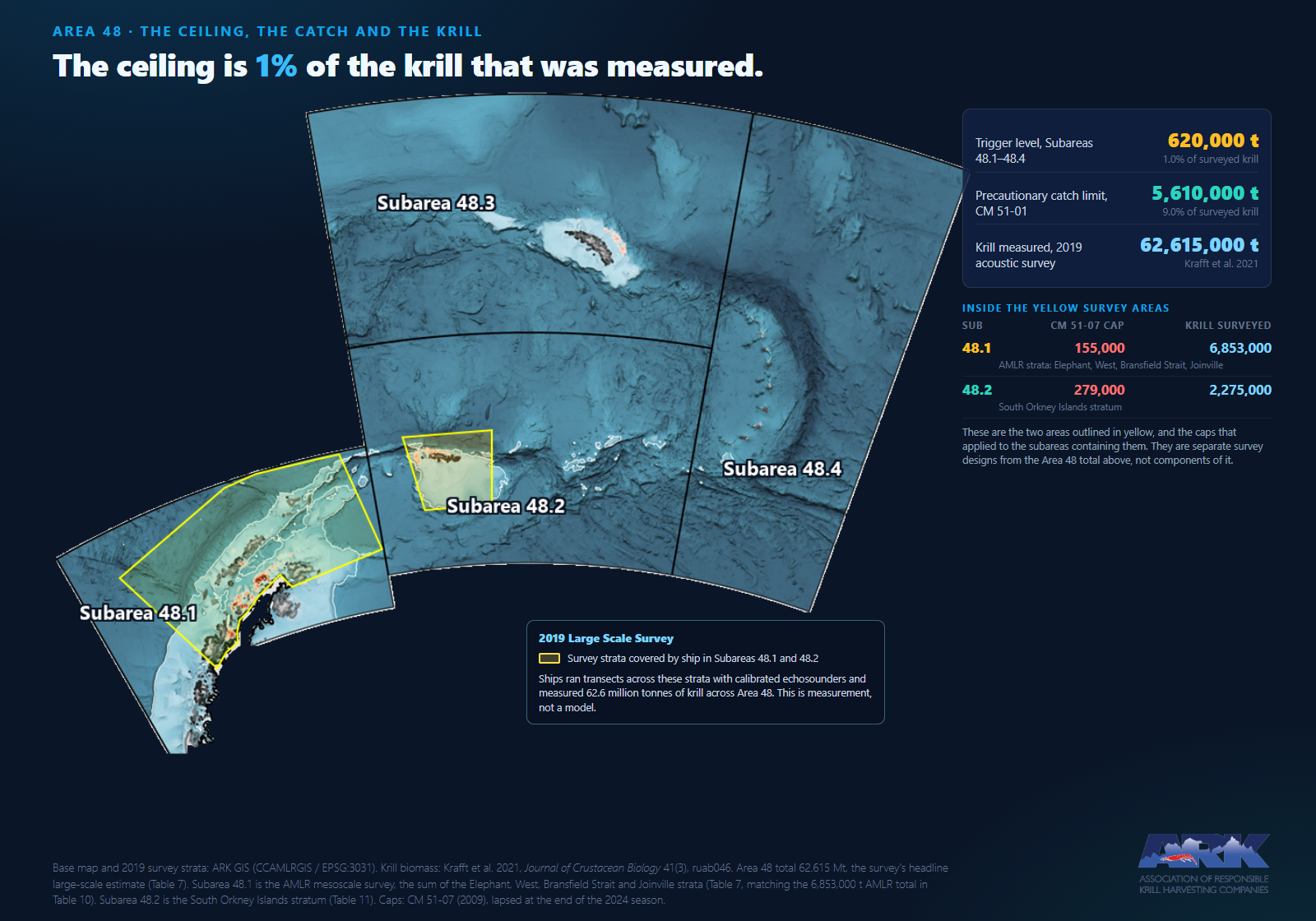
Across Area 48 as a whole, the rule that governs how much krill may be taken is stricter than the rules used for comparable species elsewhere. The comparison only works if every limit is expressed as a share of the unfished stock, so here they are. CCAMLR's krill rule selects a harvest rate that keeps median spawning biomass at 75% of its unfished level after 20 years of continuous fishing, and holds the chance of the stock dropping below one fifth of that level to less than 10%. Area 48's unfished biomass is taken as 60.3 million tonnes, which puts the precautionary catch limit of 5.61 million tonnes at 9.3% of it, and the 620,000 tonne trigger at about 1 percent.
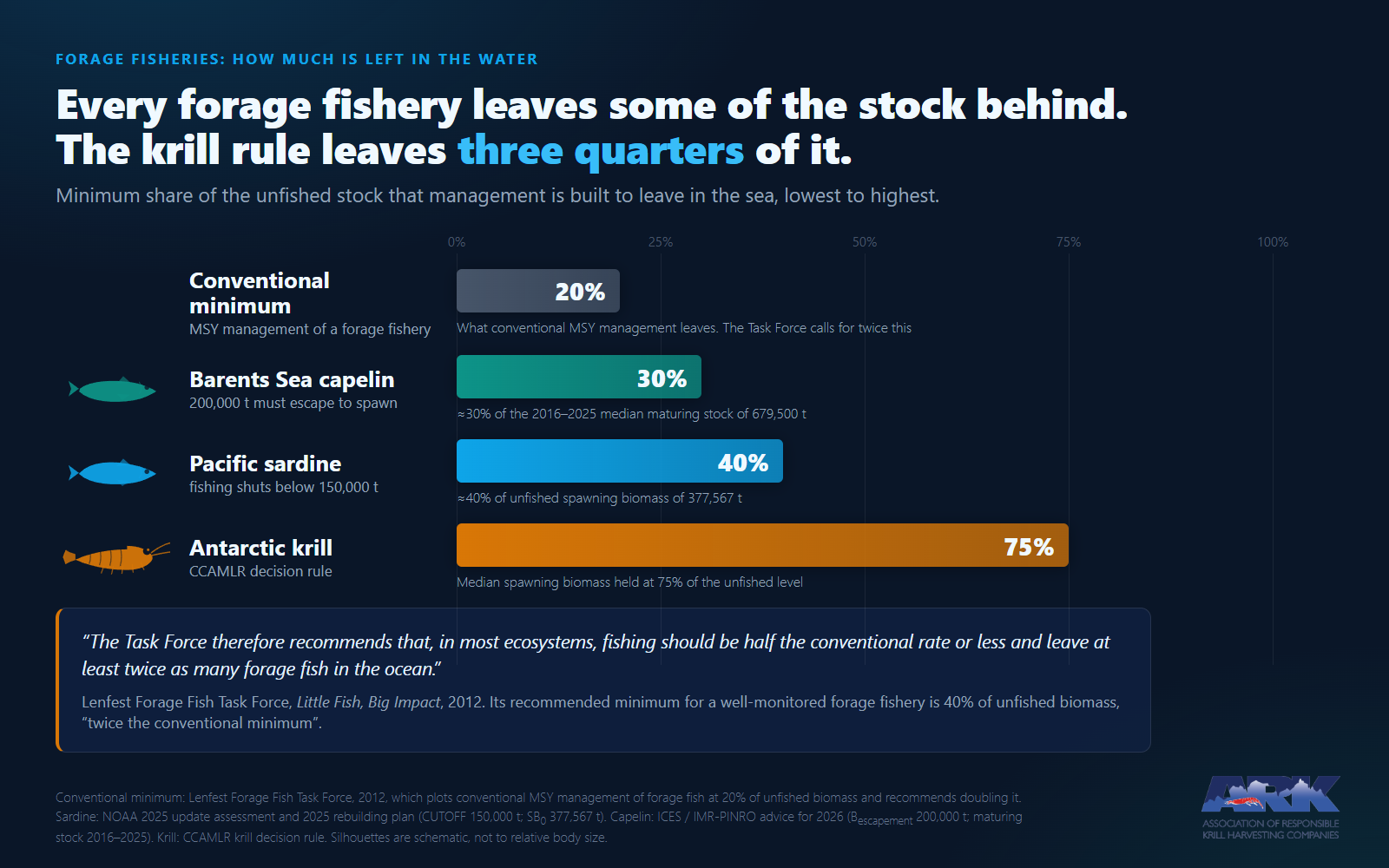
Small pelagic species that feed seabirds and marine mammals are managed on a different principle: leave a fixed tonnage in the water and take a share of what is above it. Pacific sardine shuts directed fishing once the stock falls below 150,000 tonnes, and takes up to 20% of whatever sits above that line. On the productivity scenario the US Pacific Fishery Management Council adopted, unfished spawning biomass averages about 378,000 tonnes, so that shut-off point is roughly 40% of the unfished stock and close to the biomass that produces maximum sustainable yield. Barents Sea capelin sets its quota so that 200,000 tonnes are still left to spawn, with 95 percent certainty. No unfished biomass is estimated for capelin at all, so the fair comparison is the stock itself. Across the last ten autumn surveys the maturing stock has had a median of about 680,000 tonnes, ranging from 124,000 tonnes in 2025 to 1.5 million tonnes in 2017. That puts the spawning floor at roughly 30% of a typical year's stock.
The krill rule sets a higher bar than either. It is built so that median spawning biomass stays at three quarters (or 75%) of its unfished level. That is close to the 80% the same task force reserved for fisheries where too little is known to risk anything, and krill is not one of those. It is among the best surveyed forage stocks in the world, and the rule still leaves three quarters of it, because what is left behind is not a safety margin for the fishery, it is food for whales, seals and penguins. The trigger that closed the fishery in August held the catch to about 1% of the krill actually surveyed.
That protection is set for the whole of Area 48. The Krill Fishery Management Approach takes it two steps further, and those two steps are why ARK wants it adopted. First, it calculates the catch limit from the current state of the stock: krill biomass estimated by acoustic survey at the scale of individual management units, and refreshed as new data arrives, rather than a single figure carried forward from the fishery's own catch history. Second, it decides where that catch may be taken, weighting each management unit by how much it overlaps with penguin, seal and whale foraging grounds in each season, so that fishing minimises its interactions with the animals that depend on krill. Krill matters to predators where those predators are, and the second step is what puts a number on that.
Conservation groups have pointed out that the catch in Subarea 48.1 rose between the 2024 and 2025 seasons, from 164,641 tonnes to 359,266 tonnes. That is correct, and it is worth being precise about what it is being measured against. Conservation Measure 51-07, which lapsed at the end of 2024, capped Subarea 48.1 at 25 percent of the trigger level, or 155,000 tonnes. That figure was a share of an already arbitrary total. It was not derived from any estimate of how much krill lives in Subarea 48.1, and CCAMLR has never said it was. The percentages in 51-07 were chosen to spread fishing effort. Measuring last season against 155,000 tonnes therefore sets one number that was not based on krill abundance against another that was not either. The case for spatial management is strong, but it does not rest on that comparison.
It is also worth being clear about what concentration means here. Even without 51-07 in force, the fleet did not fish a single spot. In 2025, the most recent season with catches published by area, fishing took place in two subareas and across three main grounds: the Gerlache Strait, the Bransfield Strait and the waters around the South Orkney Islands. The 2026 season followed the same pattern, with catches taken across Subareas 48.1 and 48.2. On CCAMLR's own figures the Gerlache and Bransfield straits cover about 80,000 square kilometres between them, an area larger than Scotland. From the Gerlache Strait to the South Orkney Islands is close to 1,000 kilometres, about the distance from London to Milan. That is the scale this fishery works at, and it is a long way from a fleet parked in one bay.
ARK members are also building the data the new system will run on. The Krill Fishery Management Approach needs regular biomass estimates at management unit scale, and CCAMLR's Scientific Committee has said that using fishing vessels to run acoustic surveys within those units will be essential to obtaining them. That work is already underway. Five acoustic surveys carried out by fishing vessels between 2022 and 2026 around the South Shetland Islands and in the Bransfield Strait were presented to CCAMLR in July and feed directly into the next iteration of catch limits for Subarea 48.1. Every krill vessel in Subareas 48.1, 48.2 and 48.3 has carried a scientific observer 100% of the time since 2020, and CCAMLR has recognised that observer-derived biological data underpin future management approaches including the KFMA. Vessels collect krill length, sex and maturity data to CCAMLR protocols, report catch and effort on a five day cycle, and file annual operational reports. ARK members supported the 2019 synoptic survey that produced the biomass estimate the whole system rests on.
Members have also acted ahead of the rules. Nearly 90% of the catch around the Antarctic Peninsula came after 1 April, outside the penguin breeding season. Since 2019, members have kept about 74,000 square kilometres of buffer zones around major penguin colonies closed from 1 October to 1 March, and GPS tracking data published earlier this year confirmed that those 40 kilometre zones cover the range penguins forage while breeding. Voluntary measures are not a substitute for a binding rule, and ARK has said so since 51-07 expired.
ARK is urging CCAMLR to adopt the Krill Fishery Management Approach when Members meet in October, beginning with Subarea 48.1: catch limits calculated from the current state of the krill stock in each management unit, and distributed so that catch is taken where it overlaps least with feeding predators, updated as monitoring data arrives.
ARK is not asking for a larger catch. It is asking for the catch to be governed where it is taken, on numbers that come from krill biomass and predator needs rather than from the fishery's own history. Two early closures in a row are not a signal that the stock is failing, and they are not a signal that it is thriving. They are a signal that the catch rule is doing its job, and a reminder of why ARK wants the Krill Fishery Management Approach adopted: limits matched to the stock, and catches placed where they interact least with predators.