
ARK presented a proposal at CCAMLR-45 in Hobart to implement new krill management in stages, backed by eight seasons of voluntary action. By the close of the meeting on 30 October, CCAMLR reported broad convergence among members toward this staged approach. A final agreement remains ahead, and members committed to advancing the framework before CCAMLR-46 in October 2027.
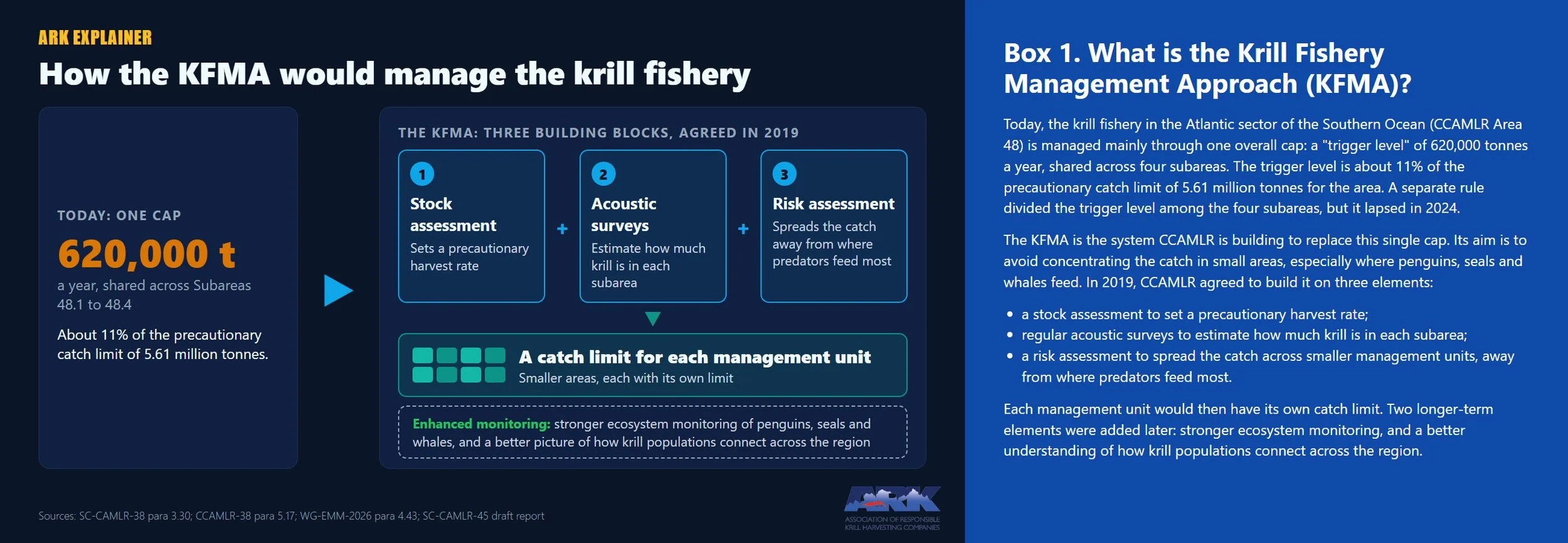
Two measures sit on the table. The Krill Fishery Management Approach (KFMA) distributes fishing across a wider area. The Domain 1 Marine Protected Area (D1MPA), proposed by Argentina and Chile, covers the waters around the Antarctic Peninsula and the South Scotia Arc. ARK supports the joint implementation of the KFMA and D1MPA where necessary, using a step-by-step process: execute each step, monitor performance, adjust the measures, and move to the next stage. In a paper to CCAMLR, ARK demonstrated the completion of all three KFMA building blocks agreed upon in 2019 for the Antarctic Peninsula (Subarea 48.1): a stock assessment, regular krill biomass estimates from acoustic surveys, and a method to spread catch across smaller areas. Throughout the two-week meeting, ARK worked with delegations on draft texts to align the joint implementation of both measures.
ARK Members have backed the KFMA through voluntary actions:
Penguin protection zones. For eight consecutive seasons, Members have kept their vessels out of voluntary restricted zones (VRZs) around penguin colonies in Subarea 48.1. These zones close 74,400 square kilometres of foraging habitat during the peak breeding season. Hope Bay has remained closed to fishing year-round since December 2020.
Spreading the catch. After the rule dividing catch between subareas lapsed in 2024, Members have started the season around the South Orkney Islands before moving to the Peninsula. In the 2025/26 season, 12.9% of the Antarctic Peninsula catch occurred during the penguin breeding season, with vessels taking the entire share outside the VRZs.
Surveys. Member vessels sacrifice fishing time to run the acoustic surveys behind the KFMA krill estimates. Two Member vessels completed surveys in 2025/26.
Science workshops. ARK has co-funded the 2019, 2024 and 2026 KFMA workshops for Subareas 48.1 and 48.2, including work to harmonize the KFMA and D1MPA frameworks.
Negotiations advanced during the session. In the closing release, CCAMLR reported "progress made towards finer-scale management of the krill fishery" and "a general convergence of Members' positions towards staged implementation" of the KFMA and the D1MPA. The Commission held several informal meetings over the two weeks to build consensus on implementing both measures together. Draft texts on catch distribution and special protection areas provided a concrete basis for talks. Members did not resolve all remaining differences in the available time, and CCAMLR did not adopt either measure this year.
Work continues over the coming year. The Commission agreed to maintain intersessional discussions and encouraged members to talk in informal formats. The Commission asked members to circulate draft conservation measures early for review before CCAMLR-46. Delegations also discussed holding a Special Meeting. The United Kingdom announced a voluntary contribution of £300,000, which includes support for agreed meetings between annual sessions.
"We were closer this year than many expected" said Javier Arata, Executive Officer of ARK. "ARK Members are ready to fish under a spatial management system and alongside a marine protected area. We will spend the coming months helping close the remaining gap."
ARK will work with all CCAMLR members and scientists to advance the KFMA and support the joint implementation of the KFMA and D1MPA in 2027.
Box 2. What is the harmonisation process?
The KFMA decides where and how much krill can be caught. The Domain 1 Marine Protected Area (D1MPA) decides which waters are protected, and how. Both cover the same waters around the Antarctic Peninsula, so they need to fit together: catch limits for each management unit must account for the areas closed to fishing, and monitoring for both should work as one programme. Harmonisation is the work of designing the two measures as a single package.
The process has moved through a series of meetings:
2024, Harmonisation Symposium (Incheon, Korea). The symposium produced options for the D1MPA layout together with catch limits for management units around the Antarctic Peninsula (Subarea 48.1). ARK co-funded the symposium.
2026, Subarea 48.2 workshop (Hazyview, South Africa). The same work began for the waters around the South Orkney Islands (Subarea 48.2). The workshop agreed the stock assessment tool and identified candidate core areas. ARK funded the venue and logistics.
2026, CCAMLR-45. The Scientific Committee recommended a roadmap with a staged approach to fully implementing the KFMA and the D1MPA, and the Commission reported general convergence among members toward it.