
Krill, whales, and the fishery: what the science shows
Whenever Antarctic krill makes the news, the same claim returns: a growing industrial fishery is taking food from whales and pushing the catch toward reckless levels. The confusion is worth clearing up, because the science tells a more precise and more reassuring story.
The story rests on three things often run together but in fact separate: how much krill there is, how much the fishery takes, and what is happening to the whales that share these waters. Taken one at a time, the evidence points the same way.
How much krill there is, and how much is fished. In the austral summer of 2019, five nations sent six vessels across Area 48, spending 108 days at sea and covering more than 10,500 nautical miles of survey transects, in the first large-scale krill survey of these waters in nearly two decades. The result, endorsed by CCAMLR's Scientific Committee, was about 62.6 million tonnes of krill. That is close to the 60.3 million tonnes measured in 2000, which shows the stock has stayed broadly stable across twenty years. Against that backdrop, the catch limit in Area 48 is 620,000 tonnes, less than 1% of the surveyed biomass. Even the higher figure now under discussion, around 1.1 million tonnes, would stay close to 2%. These are not catch targets. They are precautionary ceilings, set well below what the science considers safe, with room for natural year-to-year swings.
What CCAMLR is discussing. A proposal to revise the catch limit is not deregulation. It is part of a package the CCAMLR's Scientific Committee has worked on for years: a new krill management approach that spreads catch across smaller management units to prevent local concentration, a feedback element that adjusts to monitoring data, and a Marine Protected Area for the Antarctic Peninsula and South Orkney Islands. ARK supports this process and takes an active part in its development. The concentration critics rightly flag, where Subarea 48.1 took 58% of the 2025 catch, is what the lapsed catch subdivision used to prevent and what the new approach is designed to fix. Nothing changes without consensus: CCAMLR decisions need the agreement of all 27 Members, so no single state or company has the power to force a higher limit.
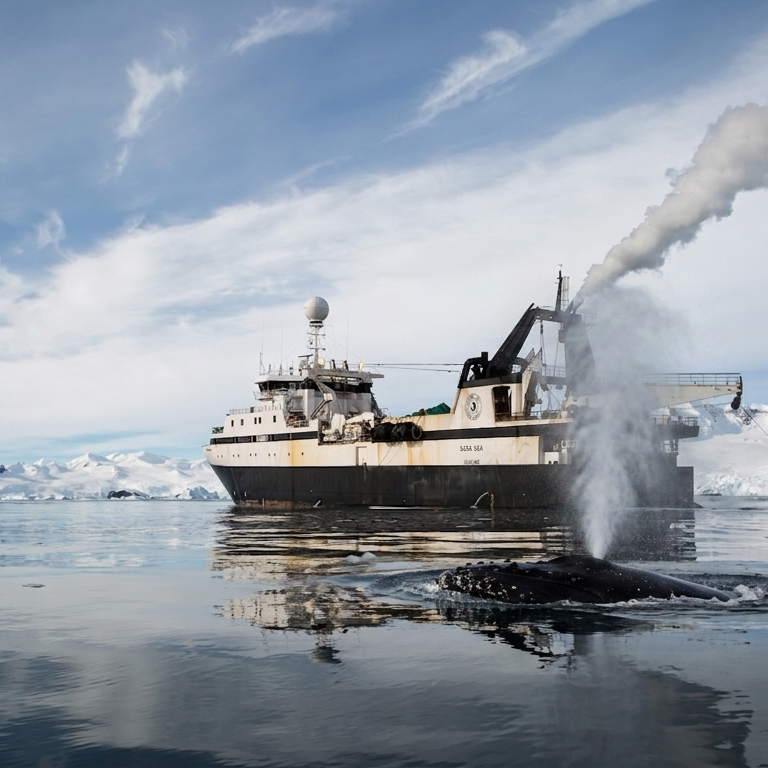
Recovery alongside an active fishery, not in place of it.
Climate and fishing are not the same pressure. Warming waters and shifting sea ice are reshaping where and how much krill the Southern Ocean produces, and ARK takes that seriously. The regulated fishery is a separate and far smaller factor, and decades of monitoring give no sign of it depleting the stock. The two large-scale surveys, nineteen years apart, returned almost the same figure: 60.3 million tonnes in 2000 and 62.6 million tonnes in 2019. The standing stock has held steady across two decades. Krill also rises and falls naturally from year to year without trending down. A decade of annual surveys around the South Orkney Islands (Subarea 48.2) found biomass oscillating between about 1.4 and 7.8 million tonnes with no long-term trend (Skaret et al. 2023), and surveys off the South Shetland Islands (Subarea 48.1) across 2013–2019 showed the same wide natural variability, with a slight increase if anything rather than a decline (Wang et al. 2025). Where the fishery works intensively, it has left the krill unchanged: an analysis of six years of trawl data and more than 160,000 measurements in the Bransfield Strait and South Shetland Islands found rising fishing effort had not reduced the size of individual krill (Zhao et al. 2025). The pressure on krill that matters most is climatic, not a fishery taking around 1% of the stock.
The whales are recovering. The clearest evidence sits in the same waters the fishery works. The Institute of Marine Research has run an annual survey around the South Orkney Islands every summer since 2011, and the peer-reviewed record through 2025 shows fin whales increasing significantly over that period. In February 2026, observers recorded more than 100 humpback whales feeding in a single location. Across the wider Antarctic Peninsula and Scotia Sea, survey data show fin whales rising from roughly 3,400 to more than 18,000 individuals between 2011 and 2023, and humpback whales have rebounded to about 80% of their pre-whaling numbers globally. This recovery has happened alongside an active krill fishery, not in place of it.
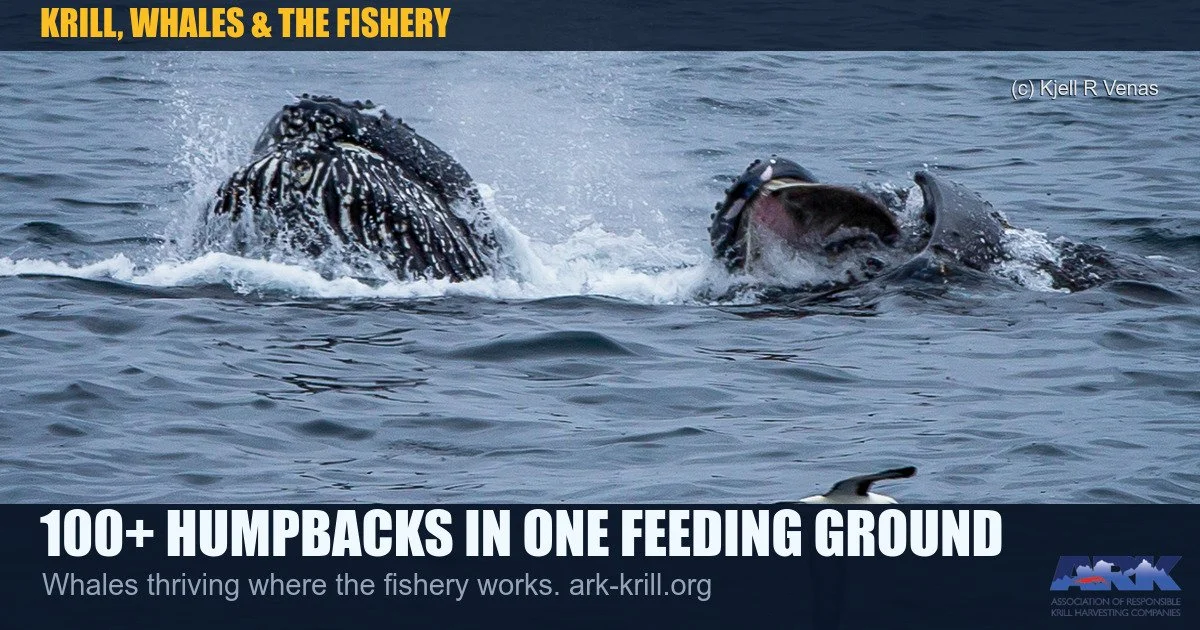
How the fishery is managed on the water. ARK Members go beyond the rules. They keep vessels away from active penguin colonies during the breeding season through voluntary no-fishing zones, carry independent scientific observers on every voyage, and fit whale exclusion devices to reduce the risk of accidental entanglement. ARK is also studying whale–vessel interactions directly, with dedicated observers aboard krill trawlers, so mitigation rests on evidence rather than assumption. The Marine Stewardship Council certifies the fishery.
Put the three pieces together and the picture is consistent. The krill stock is large and stable, the catch is a small and capped fraction of it, and the whales that depend on krill are recovering in the very area the fishery operates. That is not a system in crisis. It is a precautionary, science-based system working as intended, and ARK's commitment is to keep it that way.
References
• CCAMLR (2019). Large-scale synoptic krill survey of Area 48: biomass ≈62.6 million tonnes (cf. 60.3 million tonnes in 2000); endorsed by the CCAMLR Scientific Committee. https://www.ark-krill.org/krill-survey-2019
• Skaret, G., Macaulay, G.J., Pedersen, R., Wang, X., Klevjer, T.A., Krag, L.A., Krafft, B.A. (2023). Distribution and biomass estimation of Antarctic krill (*Euphausia superba*) off the South Orkney Islands during 2011–2020. *ICES Journal of Marine Science* 80(5):1472–1486. https://doi.org/10.1093/icesjms/fsad076
• Wang, X., Zhang, J., Yu, X., Zhao, Y., Fan, G., Ying, Y., Zhu, J., Liu, L., Mu, X., Xu, Q., Xu, Y., Zhao, X. (2025). Inter-annual variation of Antarctic krill (*Euphausia superba*) density around the South Shetland Islands during 2013–2019. *ICES Journal of Marine Science* 82(8):fsaf083. https://doi.org/10.1093/icesjms/fsaf083
• Zhao, G., Li, S., Yang, J., Zhang, G., Xu, B., Liu, H., Rao, X., Lian, P., Huang, H., Li, L. (2025). Population dynamics and body size structure of the Antarctic krill *Euphausia superba* in the Bransfield Strait and South Shetland Islands. *Biology* 14(11):1561. https://doi.org/10.3390/biology14111561
• Krafft, B.A., Menze, S., Skaret, G., Krag, L.A., Biuw, M., Lindstrøm, U., Trathan, P., Nøttestad, L., Ahonen, H., Kelly, N., Lowther, A. (2025). Abundance and distribution of fin and humpback whales at the South Orkney Islands in the austral summers 2011–2025. *ICES Journal of Marine Science* 82(9):fsaf158. https://academic.oup.com/icesjms/article/82/9/fsaf158/8245691
• CCAMLR. Krill fisheries. https://www.ccamlr.org/en/fisheries/krill-fisheries