
Research enabled by Antarctic krill fishery delivers new insights into krill, predators and ecosystem dynamics
During 2025, 14 peer-reviewed scientific publications were published through collaborations involving ARK members, including logistical support, data provision, and access to operational platforms. This body of work addresses three priority areas relevant to ecosystem-based management under CCAMLR: krill dynamics, behaviour and population structure; predators, ecosystem interactions and overlap with the fishery; and acoustic methods and gear performance.
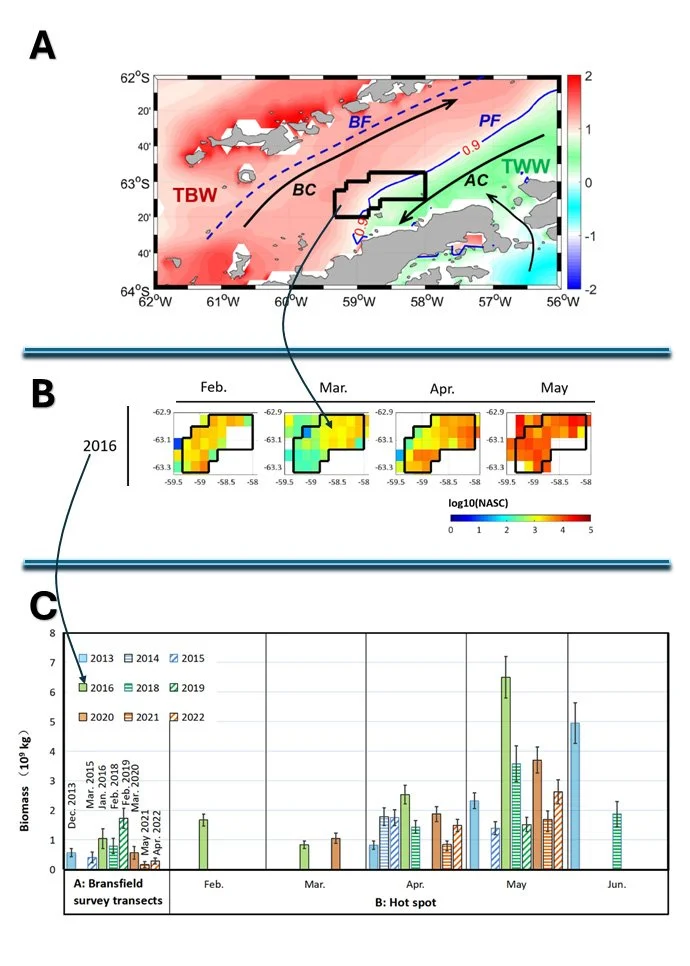
Krill density at a Bransfield Strait Hotspot (A) was surveyed from summer to winter (B). Results shows that krill biomass at the hotspot during autumn (C) was several times the levels estimated from summer acoustic surveys (Zhao et al. 2025).
The first group of studies strengthens understanding of krill transport pathways, spatial structure and variability in key regions of Subarea 48. Results identify the Weddell Sea as an important source of krill to the South Orkney Islands, with sea-ice conditions influencing the magnitude and timing of this contribution (Freer et al. 2025). Complementary work in the Bransfield Strait and South Shetland Islands shows that krill abundance and distribution are highly heterogeneous, with most biomass concentrated in large, dense swarms rather than spread evenly across the region (Wang et al. 2025). Seasonal analyses further show increasing krill density from summer to autumn in the Bransfield Strait, with biomass in local hotspots during autumn reaching several times the levels estimated from summer acoustic transect surveys covering the full stratum (Zhao et al. 2025). These findings underline the importance of spatial and seasonal structure when interpreting survey results and assessing ecosystem availability.
A second group of publications focuses on predators and ecosystem interactions, with direct relevance to discussions on spatial overlap and operational risk. Bahlburg et al. (2025) developed a method to map predator–vessel encounters using vessel-based acoustic data, providing the first fleet-scale, acoustics-based assessment of underwater predator presence around krill fishing operations. This work supports more objective evaluations of encounter likelihood at operational scales. Krafft et al. (2025) presented 15 years of whale survey estimates around the South Orkney Islands, identifying a significant increase in fin whale abundance over the study period, while no monotonic increase was detected for humpback whales. These results provide updated, region-specific information on predator abundance in an area of sustained fishing activity and inform ecosystem evaluations conducted under CCAMLR.
A third group of papers addresses the technical foundation that underpins assessment and management decisions. Krag et al. (2025) quantified trawl selectivity by sex and maturity stage, identifying systematic differences in escape probability that influence the size and maturity composition of the catch and improve interpretation of biological samples. Li et al. (2025) applied a U-Net deep-learning approach to multi-frequency acoustic data to improve separation of krill signals from noise and non-krill scatterers, reducing processing bias and improving consistency in biomass estimates. Svantemann et al. (2025) developed stereo-camera methods that will substantially increase both the number and accuracy of krill length measurements, providing higher-resolution information on population size structure during fishing operations.
Taken together, the 2025 research portfolio strengthens the evidence base for ecosystem-based management of the Antarctic krill fishery. The results improve understanding of krill aggregation dynamics and variability, provide clearer information on predator presence and overlap with fishing activity, and enhance the analytical and measurement tools used in stock assessment and ecosystem evaluation.